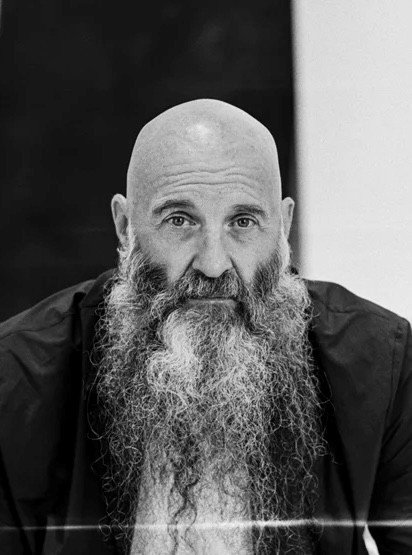
JCS: It’s a pleasure to be sitting here with you, Wolfgang. I’d first like to talk about how you got into your artistry. Did you have a specific spiritual background which brought you to want to make connections that weren’t there before? How would you describe your path into your artistic practice?
WB: That’s an interesting question. I was born in Birmingham—a vast city in the heart of England—and grew up on a council estate, one of the largest in Europe at the time. In the 1970s, it kept expanding, becoming denser, harder, more concrete. Green spaces receded as the city stretched outward.
When my father found a new job, we moved north to Cumbria, and that shift—from the intensely urban to the deeply rural—was transformative. As a child, I was drawn to animals, to painting, to music and books. Those were the things that held my attention completely.
After moving around for some time, we settled near the coast in a small town called Wigton. I was incredibly fortunate to have an inspiring art teacher, Brian Campbell, who encouraged me in ways that changed everything. We had these “careers days” at school, and the options presented were fairly narrow—farm work, factory work, the army. None of them felt like possibilities to me. My teacher simply said, “Well, you’re going to art college, aren’t you?”
Even though I was already immersed in art and its history, it had never occurred to me that it could be a life. That moment quietly set everything in motion.
JCS: Could you say a bit more about your connection to art as a practice? How does it relate to the way you make sense of the world in a larger sense?
WB: As a teenager, I was immersed in music—punk, mostly—and full of a kind of existential anger. I believed it was my duty as an artist to express whatever was inside me, to externalize it, almost like an exorcism.
But no matter how much I made, the anger never really left. Over time, though, something shifted. I travelled, spent more time in the countryside, and eventually went to Japan which had a profound affect on myself as a person and as an artist. Over the course of about a decade, I began to understand something fundamental: I wasn’t separate from nature—I was part of it.
That realization reshaped everything. My work was no longer about projecting inward turmoil outward; it became a response to something larger. A conversation. A celebration, even—especially in a time when nature feels so fragile, so precarious.
I’ve always loved making things with my hands—there’s something deeply cathartic about bringing objects into being. When a work is finished, it begins to exist on its own terms, independent of you. You leave it behind, and it continues its life elsewhere. That separation, that autonomy, is something I find very moving.
Over the course of about a decade, I began to understand something fundamental: I wasn’t separate from nature—I was part of it.
My early sculptures were rooted in expressing a sense of myself and of place, but over time, the scale and ambition grew. Years ago, I was invited to design the UK Pavilion for the World Expo in Milan. The theme was Feeding the Planet—a noble idea, though I was aware of how such events often become exercises in national self-promotion.
Still, I thought: if I could express one clear, simple idea—something honest—it might cut through the noise.
I chose to focus on bees. Pollinators are under immense threat—from climate change, pesticides, monoculture farming—and yet they are responsible for pollinating nearly a third of the food we eat. The idea was simple: to communicate their importance in a way that people could feel.
I didn’t want to lecture. People resist being told what to do. Instead, I wanted to create something immersive, emotional—an experience rather than a statement.
That led me to initiate and collaborate with an extraordinary team, including Professor Martin Bencsik from Nottingham Trent University, who studies how bees communicate. He uses accelerometers—tiny vibration sensors—inside hives to measure their activity. Bees, it turns out, communicate through vibration, through a language we can’t normally perceive.
One day, standing in a field, I held a frame of bees in my hands. It was alive—visually, sonically, viscerally. The hum, the scent of honey and pollen, the sheer density of life—it felt as though I was holding a fragment of the earth itself.
It was one of those rare moments of clarity. I thought: if I can translate this feeling—this connection—into an artwork, it might carry meaning. It might even move people to care.
The result was The Hive: an immersive structure set within a wildflower meadow. Visitors walked through the landscape, not above it but within it, and encountered this glowing, resonant form at its center. It was connected in real time to a beehive, translating the colony’s activity into light and sound.
In the studio, we discovered that the bees hum in the key of C. My daughter began to sing along with the cello and the bees. We caught this first moment on tape, it felt like an epiphany—bees, humans and sound coming together in this glorious triangle. Gradually, we built a living composition—layers of instruments and voices that responded to the hive’s activity in real time. Nothing was fixed; everything was in flux. The bees were in effect authoring the composition.
If I can translate this feeling—this connection—into an artwork, it might carry meaning. It might even move people to care.
The piece became a kind of conversation between humans and bees, between culture and nature, unfolding in the present moment. And perhaps, in experiencing that, people might begin to see bees not as small, incidental creatures, but as part of a vast, intelligent whole—a superorganism deserving of care.
Because in the end, if you love something, you are far less likely to destroy it.
JCS: This immersive sculpture you did for the World Expo sounds a bit like the one here in Charlottesville, at the Contemplative Commons. Could you say a bit more about what inspired Ninfeo?
WB: The Contemplative Commons is an extraordinary place—thoughtful, intentional, deeply engaged with questions that matter. When I was invited to create something there, I felt strongly that the work shouldn’t simply occupy the space, but emerge from it—reflect its spirit.
The idea came almost instantly. The building looks out onto a body of water, the Dell, and it felt as though there was already a quiet dialogue happening between architecture and landscape. That became the starting point.
Water, of course, is fundamental. Our own bodies are composed largely of it, which may explain its profound calming effect. Across cultures—Roman, Greek, Egyptian—water has long been revered, often through sacred spaces known as nymphaeums. I wanted to echo that tradition, to create a contemporary space of reflection centered on water.
Because in the end, if you love something, you are far less likely to destroy it.
The installation itself is deliberately dark. In Western traditions, enlightenment is often associated with light, but in Japanese aesthetics, meaning and beauty are often found in shadow—in what is partially concealed. Darkness becomes something to enter, not to fear.
Inside, thousands of glass blocks—each etched with abstracted water lilies—surround the viewer. Behind them, light and sound shift continuously, driven by real-time data from sensors placed in the Dell. The work is alive to its environment, constantly changing, never repeating.
The intention is simple: to create a space where one can sit, reflect, and become aware—of oneself, of the environment, of the subtle connections between them.
It’s quiet work, in a way. But I think there’s a certain power in that quietness. And I’ve been deeply grateful for the openness and support I found there—it made the whole process not only possible, but genuinely joyful.