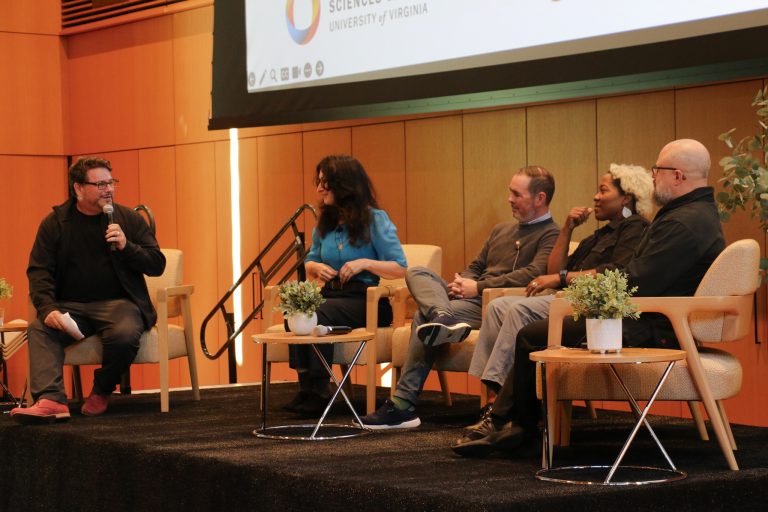
Tibet occupies a distinct—if romanticized—space within global cultural consciousness, evoking images of meditating yogis, peaceful monks, and esoteric philosophies. Less commonly appreciated, however, is the richness, sophistication, and centrality of Tibetan literary culture. On March 12th, scholars gathered at the University of Virginia’s Contemplative Commons, home to the Contemplative Sciences Center, to explore one dimension of Tibet’s vast literary heritage: metaphor. Drawing inspiration from Lakoff and Johnson’s Metaphors We Live By, which argues that metaphor is fundamental to human cognition and world-making, the Workshop on Metaphor in Tibetan Contemplative Literature sought to extend this inquiry by asking: How do metaphors—and the poetic utterances they inhabit—participate in projects of transformation and cultivation within Tibetan literature? In short, how do metaphors work contemplatively?
Organized across four sessions, the workshop combined the presentation of papers with extended discussion and close reading, culminating in roundtables among all participants. The opening session featured presentations by Andrew Quintman, Michael Sheehy, and Devin Zuckerman, moderated by Kurtis Schaeffer. The session moved from Andrew Quintman’s discussion of Milarepa’s images of military fortresses as emblems of unwavering meditative concentration, through Michael Sheehy’s presentation of rivers, waterfalls, and oceans as figures for the fluid dynamics of stabilized awareness in Dzogchen and Mahāmudrā literature, to Devin Zuckerman’s talk on broader elemental systems in Longchen Rabjam’s architectonic account of an awakened universe in which each natural element carried its own distinctive imagistic associations. Together, these presentations demonstrated how the work of metaphor in contemplative literature can express experiences of the poet as well as reorient the reader through associative connections to transform how we attend to and engage with ourselves and the world.
How do metaphors—and the poetic utterances they inhabit—participate in projects of transformation and cultivation within Tibetan literature? In short, how do metaphors work contemplatively?
The second session, moderated by Nicole Willock and featuring presentations by Tiantian Cai and James MacNee, turned to ecological metaphors. Both presenters examined oceanic imagery as a means to characterize consciousness, exploring how the embodied play of metaphor creates meaning and generates distinctive epistemic opportunities. Tiantian Cai explored metaphor in the Laṅkāvatāra Sūtra as grounded in embodied experience as well as enabling novel orientations to the world. In turn, MacNee argued that an ecological image in Longchen Rabjam’s Treasury of the Reality’s Expanse evokes the complex dynamics of awareness precisely because it resists literal reference rather than despite it. Discussions throughout this session explored how natural ecologies make available lived experiences of meaning that can be cultivated in metaphorical language to open new ways to feel, know, and attend. By the close of the first day, conversation continued to return to the central theme: Metaphor in contemplative texts goes well beyond mere ornamentation. Literary figures such as metaphor and simile are intertwined with practices of cultivation and may, in some cases, be constitutive of those practices.
The second day began with papers by Lama Jabb, Annabella Pitkin, and Nicole Willock, moderated by Michael Sheehy. Lama Jabb opened the session with a careful exploration of the refined use of metaphor in Tsongkhapa’s poetry, attending to his dense metaphorical imagery and use of classical poetic figures. Annabella Pitkin then examined the generative power—and occasional deliberate exhaustion—of metaphor in the writings of Kunu Lama Tenzin Gyaltsen, considering how the practice of creating poetic language can function as a contemplative practice, as well as when language reaches its limit. Nicole Willock concluded the session with her paper on praise poetry dedicated to Yangchenma in the work of two of Tibet’s towering literary figures, Longchen Rabjam and Tsongkhapa. In the field of Tibetan Studies these two figures are too often read through the lens of sectarian polemic, but Willock’s attention to their concern with poetry as a core mode of devotion reveals unexpected common ground.
One particularly memorable moment came when Willock invited participants to read two anonymous verses and determine their authorship. While the room was split in terms of success, the exercise prompted reflection on the distinctive textures and sensibilities of poetic voice. Within this moment of close engagement, Lama Jabb offered a reading of uncommon depth, tracing the role of the verses’ phonetic resonance—alliteration, assonance, the sonic architecture of the verse—as a means to cultivate affective and contemplative states. As praise poems, the description of devotion on the part of the devotee is secondary to its evocation through non-semantic techniques. Though not the use of metaphor, this occasion allowed the scholars in attendance to sink into the poetic depth and context of Tibet’s contemplative literature.
The final session, moderated by Devin Zuckerman, featured papers by Julie Regan and Kurtis Schaeffer on two particular metaphors. Regan examined space as the central figure for the awakened mind in Longchen Rabjam’s Treasury of Reality’s Expanse, while Schaeffer offered an investigation of the semantic range of the metaphor of entering in Śāntideva’s classic Entering the Way of the Bodhisattva. Regan’s paper focused on an almost paradoxical passage where space is the image for the awakened mind precisely because it cannot be described as having any quality. Nonetheless, we catch a glimpse of what is meant when saying the awakened mind is like space, even when that means we cannot say it is like anything at all. Schaeffer returned to a project in the lineage of Lakoff and Johnson to trace how metaphors based on the image of entering structure a range of semantic possibilities, including the ability to indicate engaging, undertaking, applying, connecting, approaching, and more.
Particularly striking was Regan’s reflection on advice she once received from a lama concerning one’s preparation for their own death, such as facing a terminal illness: If possible, she was told, one should go to a place where they can gaze upon the vastness of the ocean. If this is not possible, however, they should read the Treasury of Reality’s Expanse to discover an experience of a similar vastness. Contemplative poetry is not the mere communication of abstract ideas. Through metaphoric structures—and a host of poetical figures and resources—contemplative literature occasions genuinely transformative experience.
Metaphor in contemplative texts goes well beyond mere ornamentation. Literary figures such as metaphor and simile are intertwined with practices of cultivation and may, in some cases, be constitutive of those practices.
Contemplation as a category of scholarly reflection has grown tremendously over the past thirty years, drawing contributions from the cognitive sciences, philosophy, textual histories, anthropology, and more. Yet this workshop’s focus on metaphor illuminated a dimension of contemplation that remains underexplored in the modern academy despite its centrality in Tibetan traditions and cultures: the deeply entangled role of literature with practices of cultivation. Texts do not just describe the procedures of practice but play a role in shaping attention, cultivating perception, and practicing virtues. This insight is especially significant because—unlike personal mystical experience—poetic works are available publicly, at least in principle. Much of what constitutes a contemplative life is irreducibly interior. Poetry, by contrast, is shared. Emerging from the deep interiority of the poet, poems reach through language to invite readers into new ways of seeing, attending, and knowing. In this sense, the workshop itself embodied the phenomenon it sought to understand: the collective act of reading, reflecting, and sharing contemplation as a shared and living practice.