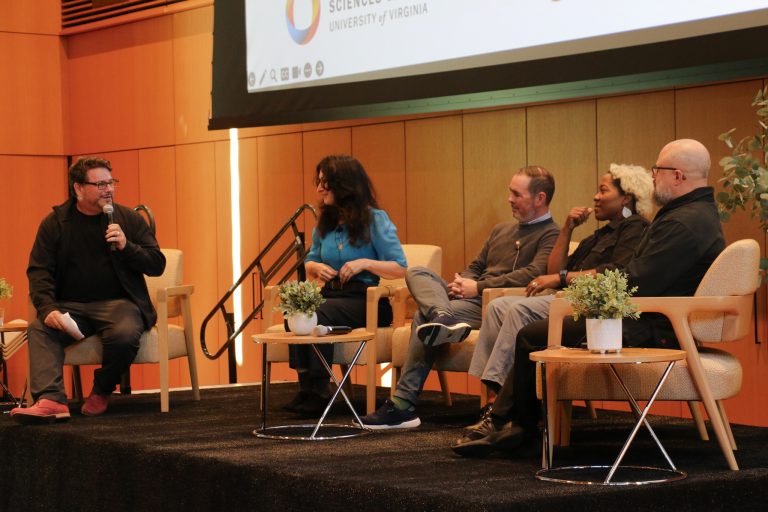
With an Honor Song ringing out, resonantly, at an AAR panel, it’s clear that contemplation as a category, as a way to collect voices, perspectives, and insights, is not just a recapitulation of tired and ingrained modes of academic pursuit. While Contemplative Studies as an organized and self-conscious field is still quite young, the study of contemplation is ancient. For millennia humans have queried the mechanisms of transformation through somatic, ecological, attentional, spiritual, communal, and intellectual practices. This process of genuine curiosity and experimentation within contemplation meant that contemplative techniques and technologies frequently traversed boundaries of tradition, power, and geography. This resonance of contemplation across boundaries—and the necessity to nourish this transmission today—was a central theme throughout the Contemplative Studies Unit’s sessions at the American Academy of Religions 2025 annual meeting in Boston.
Perhaps no session better embodied this than the book panel on Yuria Celidwen’s Flourishing Kin. This book draws upon Indigenous traditions, in particular the Nahua and Maya, to offer a vital critique of WEIRD (Western Educated Industrialized Rich Democratic) cultures. In doing so, Celidwen argues for the necessity of founding and nourishing relations of kinship with the human, non-human, and living world—something which Indigenous cultures have done and continue to do. Celidwen offers practices of honesty and relationality to foster such relations, recognizing that mere words are not enough (WEIRD academia is, of course, no stranger to critique). For genuine transformation toward flourishing, practices grounded within communal, ecological, and embodied realities are necessary.
For genuine transformation toward flourishing, practices grounded within communal, ecological, and embodied realities are necessary.
Two of the panelists deserve special mention. First, Larry W. Gross asked the question, if Flourishing Kin is written for WEIRD folk—to bring them critiques, wisdom, and practices of reconciliation—what does it mean to him as an Indigenous person immersed within his own tradition? In short, it still means a whole lot. Gross finished his discussion with an Honor Song, recognizing Celidwen’s resilience, passion, and work for human and non-human flourishing. Next, Oludamini Ogunnaike connected directedly with Celidwen, acknowledging the pain and fire from which Flourishing Kin was born. It is not a book that is meant to make its WEIRD readers feel better for the sake of feeling better. This is not new age self help. It is a book committed to honesty and truth, and insofar as it is that, it acknowledges the pain, the violence, and the erasure that Indigenous cultures and the natural world have faced at the hands of WEIRD hegemony. While the discussions described above were scholarly in nature—with all the attendant rigor and sharpness of critique—each was personal, the speakers connecting with Celidwen directly. Something not easily put in words, though perhaps more powerful than can be expressed here, passed between Celidwen and these panelists as their gazes connected and held; something honest, something vulnerable, and something revolutionary.
While each of the other panelists offered key insights, for sake of space, we can only mention in passing each of their contributions: Seth Schermerhorn began the panel by presenting his personal journey of reading and being transformed by Flourishing Kin; John Dunne offered a contextualization of the book by connecting it to three others, The WEIRDest People in the World by Joseph Henrich, The Dawn of Everything by David Graeber and David Wengrow, and Goliath’s Curse by Luke Kemp; Devin Zuckerman connected Celidwen’s book to integral work by Himalayan Buddhists to sustain and foster ecological practices of relationality; Michael Ing offered Confucian views of relationality as ever-widening circles of connectedness and responsibility; and Kimberly Carfore walked the gathering through experiences of introducing students and faculty to the transformative, if difficult, practices of being honest with ourselves about the harm we have done the natural world while at the same time fostering new, deeper connections with it. This session demonstrated a care and vulnerability all too rare within academic settings. It is something significant for us to attend to: the ways in which embodied, relational being can ground our intellectual pursuits and, perhaps, enable them to flourish in ways overlooked by ordinary modes of the academy.
This session demonstrated a care and vulnerability all too rare within academic settings.
The next panel organized and hosted by the Contemplative Studies Unit was “Contemplative Epistemologies: Diverse Methods and Practices.” The panel focused upon the ways in which contemplative traditions from across the world offer unique and valuable modes of knowing. The first paper, by Dhruv Nagar, displayed how ontological categories within classical and medieval South Asian philosophical traditions offer textual and hermeneutic practices that shift and move the reader’s attention from the corporeal to the incorporeal. Next, Haseena Sahib’s paper focused on the work of chanting and reciting the Qurʾān and Sufi poetry as practices to achieve higher states of consciousness and being. Particular attention was paid to how the form of the poetry worked to move the reciter through contemplative phases. Finally, Marianne Florian employed the framework of 4E cognition to show how participants within a Cognitively-Based Compassion Training enact the meaning of practice within an embedded environment. These participants were active co-creators of the practices’ meanings in response to their own needs and goals. As respondents Devin Zuckerman and Adam Liddle noted, each of these papers showed how, in diverse contexts, contemplatives come to experiment with methods and modalities of knowing.
The third panel hosted by the Contemplative Studies Unit was “Confucian Contemplative Practices of Self-Cultivation.” This panel organized papers in the understudied dimension of Confucian contemplative practices to show their vital place within the tradition, from ancient tradition to modern adaptation. Jung Lee kicked off the panel by investigating the medical traditions influence within the Mencius, paying particular attention to how psycho-physiological energies impact one’s cognitive ability to come into harmony with the design of Heaven. Next, Ryan Pino revisits a long noticed but still little understood parallel between Zhu Xi’s meditative reading and lectio divina. Both, Pino argues, do something particular in using reading as a mode to encounter genuine otherness, whether that be an encounter with the divine or the greatness of past masters. Jea Sophia Oh followed this discussion by exploring the significance of reverence within Korean Confucianism. Oh argued for a reframing of reverence as reciprocal, not just reinforcing the authority of those in power but allowing genuine relationality and respect beyond distinctions of gender, class, and race. The possibility of such reverence in Confucianism opens up broad eco-feminist applications to foster interdependence within society and with the natural world. Finally, Shumo Wang presented on the practice of online journaling within the modern Kongyang Confucian Fellowship. Wang’s discussion revealed how the act of journaling becomes a medium of transformation—from solitary seated or walking meditation, to reflection and writing, and then, ultimately, to a form of communal engagement, leveraging digital technology to create community and relationality around experiences of internality. Respondent Bin Song noted, in closing, the significance of contemplation as an organizing category bringing together diverse methods and topics as well as historical periods and localities of Confucianism together into discussion.
The final panel hosted by the Contemplative Studies unit was “Contours of Freedom: Contemplative Practices in Jain Thought and Literature.” This panel, in particular, demonstrates the ways in which contemplative methods can travel between and through traditional boundaries, finding resonances within new contexts that enable novel and meaningful engagement. The first paper, presented by Morgan Curtis, examined, the Cīvakacintāmaṇi, to show how narratives about animals can shift our attention and catalyze intense emotions to reveal our relationality and responsibility to animals and, ultimately, reshape how we engage our given worlds. In this way, the text becomes a play of attention, shifting the reader to a position in which they can see the value of renunciation for the sake of living beings. In the second paper, Alba Rodrigues Juan presented the ways in which Jain authors like Yaśovijaya engage different Yogic systems to weave together multiple classical sources to create a uniquely Jain interpretation of Pātañjali. Next, Christopher Miller’s paper argued for the influence of non-Jain systems, particularly Tantra and Haṭha-yogic systems on Sushil Kumar’s 20th century presentation of Jain yoga. Finally, Samani Pratibha Pragya investigated another 20th century figure, Ācārya Mahāprajña, to show the ways in which targeting secular audiences can reshape the types of practices a master of a given tradition takes as central. All of these papers demonstrate the ways in which contemplation—in its plurality of methods and modalities—is responsive and resonant across boundaries. In this, contemplation is consistently a methodology of movement, of transformation to reshape how we relate to the world and ourselves. The Contemplative Studies Unit at this year’s AAR demonstrates, definitively, the value of taking contemplation as an organizing tool to think beyond the boundaries, borders, and hierarchies that usually shape our thought.
All of these papers demonstrate the ways in which contemplation—in its plurality of methods and modalities—is responsive and resonant across boundaries. In this, contemplation is consistently a methodology of movement, of transformation to reshape how we relate to the world and ourselves.