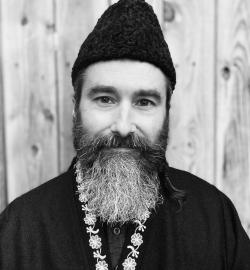
JCS: I’m so happy to have this opportunity to speak with you, Pir Zia. I’m interested in how you stumbled into the spiritual and contemplative path of your life. Was there anything in your upbringing that encouraged or facilitated this way of living? It does sound like you’ve had a pretty intercontinental life. Did that play a part at all?
PZ: Yes, thank you. Well, it’s a pleasure to be speaking with you. And in my case, my entry into Sufism began, I would have to imagine, before I was born. Because I was born into a family that carried Sufism as its lineage. And, in fact, already since birth, there was an expectation on my parents’ part that I would not only follow this path, but that I would be a carrier of the path into the future. My father followed in the footsteps of his father who had first brought Sufism to Western Europe and North America 100 years ago.
His father left this world when he was 10 years old. I think that, for my father, this meant that he appreciated how much could be transmitted and needed to be transmitted in our early years of life, since all that he had received from his father came so soon. He wanted to pass on to me what he could from the start. And so I grew up immersed in what he had to give me in the form of instruction. And, of course, by his own example. My mother also carried Sufi teachings. I grew up in an environment of spiritual symposia, spiritual community, retreats, and so forth. So I drank it in with my mother’s milk.
JCS: That’s a beautiful statement. So it sounds like this way of life came naturally to you, almost as if you had a predisposition for it, for an openness to spiritual teachings and the contemplative path?
PZ: Yes, I think you could say that it came naturally in that way. I feel very fortunate in that regard. It doesn’t mean that my own personal life path has been without its bumps, or without its moments of hesitation or quandary. I’ve gone through my own process of investigation and discovery, which has been transformative along the way. But I thank God that I’ve been very blessed with a lot of support on every side at every step.
JCS: Would you say that your instruction in Sufism and your spiritual or contemplative practice has helped shape just how you explored the world as you grew up? And, you know, this kind of carries over into the question of our symposium, about, you know, sense-making. I guess my question is, has your grounding in a specific contemplative tradition shaped how you have made sense of not only the world, but of your own life within it, your own life path?
PZ: Yes, absolutely. It has. Specifically, in the sense that I’ve never regarded this universe as a solely, or even primarily, physical phenomenon. I’ve always had the feeling of inhabiting a multidimensional universe. And so I’ve always wanted to pursue relationships, vocational tracks, whatever it may be, in the light of not only physical fulfillment, but fulfillment at the level of mind and heart through the witnessing and creation of unfolding manifestations of beauty, and at the level of spirit through the witnessing of the Divine Presence in every moment.
I’ve never regarded this universe as a solely, or even primarily, physical phenomenon. I’ve always had the feeling of inhabiting a multidimensional universe.
JCS: So you are saying that it’s specifically your belief in the metaphysical dimensions of the universe that has led you to take certain decisions in your life?
PZ: Yes. Yes, it has. I think I have generally neglected undertakings that are aimed at outer markings of success, whether that means financial fortune or any other such indicators of a kind of fulfillment that seems to me ephemeral and ultimately likely to dissolve into insignificance. Yes, I’ve wanted instead to put at the center of everything I do the heart’s attention and the possibility of being alive and awake and in communion with the living Earth and with fellow travelers on the path. And for me, these considerations have trumped all the rest.
JCS: It’s beautiful what you are saying. I’m interested in how you’ve helped others find their own path towards the sentiments that you’ve been sharing with me today. I know, for instance, that you founded a school. So, I guess I’m curious as to how your contemplative practice, grounded in your own experience and traditions, impact how you relate to others’ spiritual journeys? Would you say that it is almost with an objective of helping them find a path in general, or more towards finding one similar to your own? I come from a Judeo-Christian background, and, often, you know, there’s a lot of evangelical perspectives, of needing to find a specific path. And so, in your circles of education, how do you conceive of the sharing of your spiritual tradition? What does the practice of sharing your belief system with others look like?
PZ: Well, in our tradition, we have a system of transmission which unfolds through training. Somone who enters our inner school does so very intentionally and in doing so “takes hand.” That’s the expression we use, to take hand with the teacher. And then, in that way, a rapport is created, a connection between heart and heart where resonance, a field of resonance, develops. And, within that resonance, there is a vessel for the unfoldment of the soul of the seeker. There is a space for the transmission of the insights and discoveries that have passed down through the generations. We don’t regard our work as merely a secluded endeavor, but we regard it as being in consonance with, and being the outflow of, the human process of awakening down the generations. And so, entering into that relationship means that one is wading into a river that goes back to very ancient times. And so, there’s a significance in taking that step intentionally and doing so within a space of dedication. One finds oneself among spiritual siblings who are similarly following the way and gathering together, meditating together, praying together and so forth. And with that comes a great feeling of companionship. But there’s a danger in that companionship, which would be that one would regard that group of fellow seeking souls as somehow separate from, or even above, the whole family of human experience. One would regard oneself as a kind of special elite and concern oneself only with one’s companions. And therein lies a trap because, actually, the real blessing of the kind of spiritual companionship that we experience in a school like this is that it opens out to an ability to empathize with, to understand, and to be available to other seekers. Because we see that we are not the only seekers of truth and that everyone was born for seeking. There are many people who meditate, who pray, who do their best. And they too are traveling, we can say, ultimately the same path. And it’s not even only those who meditate and pray. We have to realize that even those who are caught up in addictions, even those who are caught up in behavioral patterns which are destructive, everyone at their root is a portion of the cosmic consciousness that’s finding its way toward the integration of all that it experiences. And so there are no definite boundaries between one group or another, or one path or another. And we do find benefit in coming together around shared practices. But, ultimately, those practices, if they are of any value at all, are grounded in reaffirming our solidarity with all beings.
Ultimately, those practices, if they are of any value at all, are grounded in reaffirming our solidarity with all beings.
JCS: Again, I am struck by the sheer beauty of what you are sharing with me. It’s hard to come back to normal language after listening to these ideas. You mentioned to take hand is an expression of finding almost a mentor-mentee dyadic relationship in your tradition. Would you say that physical touch is an integrally important facet of that? And are there any technological ways that you’ve experimented with? Have you found that technology can impede or improve?
PZ: Yeah, that’s a wonderful question. Until recently, we always did the ceremony in person, physically, by hand, holding hands, one thumb over the other. And you feel a figure eight moving through you, a cycle of energy that moves from heart to heart through the hands. And it’s a powerful experience. You feel you’re forging a bond together, and then that bond is going to continue even when you’re physically apart. And so we always did this together. Now, sometimes, in certain interpretations of Islam, sometimes women and men who aren’t related directly, they don’t physically touch. So in those cases, the way that the touch would be done would be that you would have a vessel of water, and the initiator puts his or her hand in the water, and the one receiving the initiation puts their hand in the water, and the transmission is through the water. So, the hands aren’t touching, but the transmission happens that way. But, more recently, we’ve had so many requests for initiation from people who aren’t able to come because of geographical distance and other reasons. And so, we have started offering initiation through a livestream contact online. At first, I wondered how well the medium would serve the purpose. I found that I needed to put my hands on the keyboard while I’m looking into the screen. The keyboard, by the way, and the screen, the computer, the phone, these are devices I’ve come to regard as needing their own spiritual attention. And, rather than just treating them as a mere convenience of no account, I say prayers to consecrate devices and treat them as a part of my own energy field and approach them as repositories of so many of the speech acts and other extensions of consciousness that are flowing through them all the time. I want to treat technology as something that takes on a sacredness through the recognition of the role that it plays and all the energies moving through it. So, with that in mind, I do use the computer as a vehicle for giving initiation.
JCS: And the technology on their end? Do you speak to them about their relationship to technology? Or do you hope that your belief and your blessing of the technological pathway carries over in an intrinsic or intuitive sense?
PZ: Yes, we do. When we have group gatherings, we do take a moment to bless our devices.
JCS: Wow.
PZ: And I’m glad we’re having this conversation because we just began a new course last weekend. And I think, in the midst of everything, we have overlooked to transmit this practice to this newest group. So, this Sunday when we meet again, I’ll remind myself to do it.
JCS: Great. So, because I think we’re running out of time, I’m wondering if there’s anything that you’re still curious about in particular within your own practice and tradition. Is there, you know, a direction you feel yourself currently drawn to, whether this is an aesthetic or pedagogical something? Because I know you’re quite, you know, a verbal artist in addition to a teacher. And so, yes, I’m wondering where you see your artistic or contemplative practice taking you next.
PZ: Well, when you speak of it in terms of something attracting my curiosity, I think that being here today relates to it because I was able to enter the Ninfeo chamber here at the contemplative commons, the one that’s connected with the pond outside. Seeing how fluctuations in the pond water are reflected in the colored lights in the chamber, I found it a fascinating instrument of embracing new technology, which is quickly overtaking all of us. I was hesitant at first. I was one of the very last people to have a cell phone. And I still have some hesitation. But, since I see it taking over so much of our lives, and I see that it’s simply the medium in which we live, my curiosity is about how we can use it skillfully. What, for example, are the prospects of bringing a technological component into situating ourselves within the cosmos? Right now, as we’re speaking, are we aware of the planets circling around overhead and the intensely hot core of the Earth deep down under our feet and the tremendous, unimaginably vast and complex panorama of intersections between myriad beings on all levels of scale influencing and informing this moment? How aware are we of this? Maybe there are technological extensions that don’t disorient us but keep us grounded, that infuse that groundedness with reminders of context which we can then experientially pursue above and beyond what the device manifests.
JCS: I am glad your curiosity is pointing you towards such an important and hopeful direction. Thank you, Pir Zia, for helping ask such beautiful questions, and, again, for taking the time to speak with me. Thank you very much.