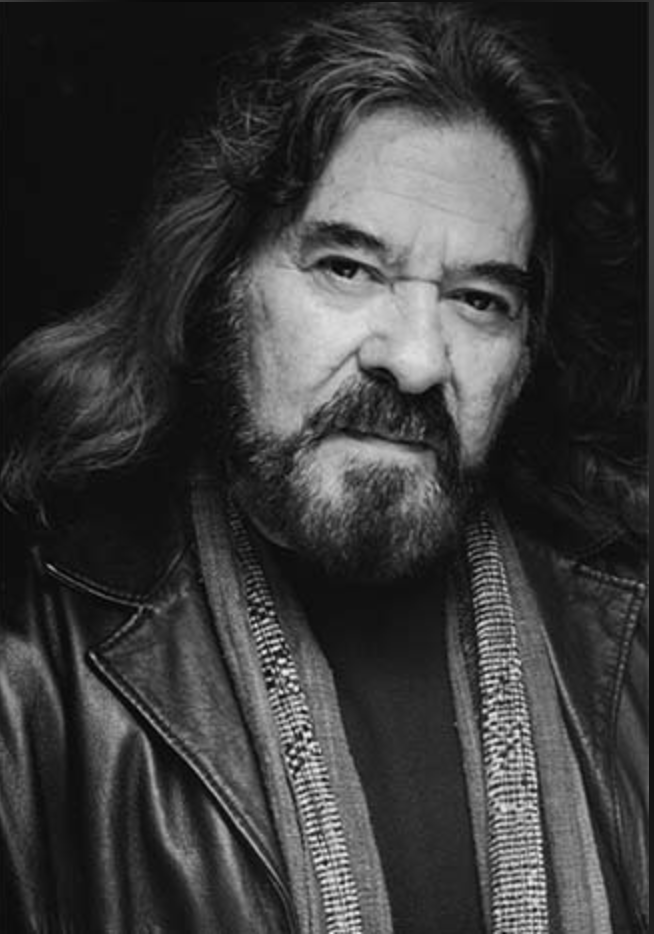
Conducted by Michael Overstreet, a doctoral candidate at the University of Virginia and a Research Assistant at the Journal of Contemplative Studies (JCS).
JCS: I’d first like to tell you what an honor it is for me to be able to have this conversation with you, Lance. I’d like to start our conversation in asking whether contemplative practices have always been part of your life. What did your upbringing look like, and did Cheyenne spiritual traditions play a large part?
LH: Absolutely. Yes, I was raised by my grandparents, which is common in my generation, as our mothers and fathers were usually victimized by the American government. I never met my father. My mother was, at the age of 6, stolen from her home and placed in a government school about 600 miles from the tribe. When I was born, she was in the Navy in Washington, D.C. and she quickly made arrangements for me to be sent to Oklahoma. When I arrived there, I was passed around from family to family, to whoever had the most money. In the 40s, I wound up with my grandparents who introduced me to the traditions of the Cheyenne world.
I was initiated into the deep ceremonies of the Native American church. This church uses the sacrament of peyote. And so, my introduction to that sacred way was fairly early on, and I grew up in that. This system of knowledge is not a belief system; it’s a knowledge system. Consequently, I became a peyoteist. I learned how to use that sacrament to heal. And I have done so on several occasions.
JCS: Could you say more, Lance, about the difference between a knowledge system and a belief system?
LH: A knowledge system is based upon personal involvement and personal ceremonial ritual. We don’t have someone to stand in front of us and tell us how to live. We enter the ceremonies to learn how to live. That is our way of knowing the world, from personal experience, not an experience that is told to us as being the correct one. I think that’s the simplest way I can put it.
JCS: And you said you started this path when you were a child?
LH: Yes, and then I graduated into the deeper Cheyenne world. When I graduated from Tulsa University, I went home and began to participate in our earth renewal ceremony, commonly known as the Sundance, and became a Sundancer for over 23 years, and then a painter. I’m one of the grandfathers in the Southern Cheyenne Sundance Lodge. I take care of and help show the supplicants the Sundance ways of looking at the world, and how they can learn to be in the world. It’s largely a hidden system, because, especially today, we don’t trust the outer world, those who don’t even wish to comprehend who we are. It is not a superior system; it’s just another system of looking at reality.
JCS: At what point did you start writing poetry? Where does poetry fit into all of this?
LH: Well, I must tell you that it took me a long time to find a way to understand and articulate the imagery I saw in the Native American church, because what I witnessed as a young kid, during healing ceremonies, I simply could not comprehend. I had the imagery captured in my mind. But I didn’t know how to articulate what I saw in the amazing reality of this teepee religion. The healing ceremonies go from dusk to dawn, and in that time, the sacrament itself leads one into a different reality. It’s not a high, it’s more being a participant in a kind of medicine. And there really isn’t a way of articulating it, it just happens.
And so, the Cheyenne world, of course, is what brought about the Cheyenne language, which is spoken entirely in the present tense. There’s no past and no future; it’s spoken in the now. And in this now, we carry all of the knowledge that we have been fortunate enough to know. I’m a Marine Vietnam veteran, and when I came back to my tribe, like a lot of the Cheyenne veterans, I was lost and angry. I didn’t quite comprehend the world I’d just left in Vietnam, or the world I was living in when I got to Oklahoma, if you can imagine. So, I threw myself into ceremonies, those that I understood could help heal the trauma I had endured. Now, poetry was always around me. It’s in the songs of the peyote ritual. It’s in the songs of the Sundance ritual, and they are often likened to the haiku. I first began to write poetry not as therapy, but as a way of paying homage to what had been given to me to survive, within the context of my grandparents’ knowledge.
The Cheyenne language, which is spoken entirely in the present tense. There’s no past and no future; it’s spoken in the now.
JCS: In preparation for this conversation with you, Lance, I heard you say something I found to be very interesting. You said to be a poet is not a burden for you, but it is an obligation. You feel obligated to be a poet. Could you say more about that?
LH: So, I was orphaned to my tribe in the late 40s. At that time, a child was owned by the tribe. Whoever had the most food, whoever had the money, who could afford to feed and take care of a child, everyone contributes what they can. We live a true socialist reality. The child is owned by and belongs to the tribe and, in turn, is open to all of the learning the tribe can offer. And, for me, I think I was born a poet. I was born in a world where I had no father and where my mother was absent, but I had my grandparents in my tribe. So, when I began public school, I became known as someone who could articulate very well the reality shaped by this. When I was 18, I gave myself to poetry. Then I had to endure military life and all the things that a man in that era had to endure to get through to the point where I could get back to my people. And that has been my goal all along. I’m very humbled by the fact that I can make a living as a poet. I have 57 books published, and most of these are outside of America, but this doesn’t do anything for me in the way of fame. I don’t care about fame. I write poetry to pay homage to the life and struggles my tribe has had to live through for over 500 years. I’m 81, and poetry gave me a life. It’s kept me well and has been my oldest friend. It’s helped bring me an amazing reality.
JCS: Thank you, Lance. How do you think contemplation and the Cheyenne spiritual tradition have affected your writing of poetry? How would you describe the relationship between them?
LH: Though I haven’t used the sacrament in 40 years, I ingested its knowledge. I can heal with it. I’m not a shaman. I’m a poet, but I am capable of using the medicines I have been given through ceremony. We’re gifted with these medicines which give us, if we persevere, what’s needed to acquire knowledge. The only reason for ceremony is to acquire knowledge and to understand one’s obligation to that knowledge.
The only reason for ceremony is to acquire knowledge and to understand one’s obligation to that knowledge.
So, poetry was something that came to me as kind of a blessing after the war. It taught me to honor those things. To honor life and fight against those who don’t understand it. Poetry, I think, exemplifies the sacred word of the Cheyenne language, Nsthoman. It’s a mirror- reality; it has to do with how the deep earth, the seed earth, and the plant life that comes out of it—they have a cosmic understanding that is their own. And, often in ceremony, they’re able to reward the person who is enduring days and days without food or water by giving the gift of their understanding. I’ve received those gifts, only a few of them. Very few, but, for me, that’s the Cheyenne world and the Nsthoman, which, I sometimes think, is the mirror-reality behind my poetry.
JCS: There’s a line in a poem of yours that really struck me and might be resonant with what you just referred to as a cosmic understanding. The line reads: “Observing the river, it sings in you. You are the river.” Would you be able to say anything more about the relationship a human individual has to the “deep earth” or Nsthoman of the Cheyenne spiritual tradition? I know you said it’s not a belief system, but is it at all similar to Buddhist or Eastern practices and traditions?
LH: There is a Native American clinical Jungian psychologist who’s a brother of mine; he is a Buddhist. There’s not even a link between them, between Buddhism and the Cheyenne tradition, but a kind of thread of knowledge. It’s a tapestry, a great tapestry of knowing. Understanding the real purpose of being a human being within this tapestry exists in all of these realities, and my people honor that. We pray for people who have knowledge of this tapestry of being. And yeah, it all sounds very Buddhist. But also, if a Buddhist were speaking, they would probably say it all sounds very Cheyenne.
JCS: How would you say your contemplative knowledge or practice has influenced the way you live?
LH: I live a medicine way, and I earned this right. We earn the right to be a human being on this planet. You are a PhD student. I have the great opportunity to be able to speak to people as a poet, and my lectures and my readings are all directly engaged with the question of how we can be more human to one another. Because this is no longer just a silly thing that we’re supposed to think about. We have to do it. We have to learn how to be human in the world. Contemplation for me involves being in touch with not just the world, but all of the worlds—the dream and the spiritual worlds—and understanding your place within them. I’ve been able to exorcise people’s homes. I’ve been doing it for years. I’ve even done it by phone once; I’ve gotten rid of entities who are trapped. And, of course, this has to do with knowledges I’ve been gifted. I’m not an exorcist, but I’m in touch with the spiritual realities around me through my practice.
Contemplation for me involves being in touch with not just the world, but all of the worlds—the dream and the spiritual worlds—and understanding your place within them.
JCS: I think you’ve already touched on this a bit, but I’m curious how you believe your practice of writing poetry anchored in the Cheyenne tradition affects the greater world, not just in a social or cultural sense, but maybe in a political one. Why do you believe your practice to be important?
LH: Well, I think you said a key word there because, just to be born a Native American is a political act in and of itself. I recently was involved in a documentary with a French film crew. I was sort of the historical spokesperson and guide. Last August we were in America for 22 days filming on some of the most forlorn reservations: Pine Ridge, Standing Rock, The Northern Cheyenne—my people in the north. Our goal was to hold a mirror to the results of colonialism. My world, starting from my first book of poetry as a sophomore in college, was to attempt to protect, but also to reveal, who my people are. And that’s a political act. For me, to be born, and literally to be born an indigenous person is, especially today, a political act, because you are born into the position of having to stand on disappearing ground, to defend the ground, to defend the rivers and the natural world.
JCS: So you’re saying that poetry is your way of helping your perspective as an Indigenous person get out into the world and to keep on living? I guess this is just as political an act as being born one.
LH: Yes, absolutely. At least that’s my response to my life as a poet. But as I have grown into this world, my work has become more . . . hermetic. And, I enjoy that, because I can now retire into the life I know with as much peace as possible. I’ve had to live a very violent life, and I simply understand now that peace and hope are the most valuable things a person can entertain.
JCS: Now that you say you have become a bit more hermetic, whether it be your spiritual practice or that of writing poetry, where do you see it taking you next?
LH: I foresee it taking me to the end of my life. I’m dedicated to protecting other life with my own. I belong to a warrior society, the Dog Soldiers, and we have vowed to protect life. All life becomes precious. We learned this the hard way in fighting America—there are only 127 of us in our tribe that’s now less than 1,400 people. It’s a warrior clan that has no standing treaty with any foreign government, including the United States. It’s a clan of the Southern Cheyenne you cannot join; they choose you according to your stature and what you’ve accomplished. I was initiated in 1978 with honor, and I try to serve the world through this initiation which is very difficult. The country we find ourselves in is the same that threatens our world. Since I’m a Dog Soldier, I must reject what continues to put my people in Oklahoma in danger—my family, my son, my daughter, and my grandchildren are in great, great danger.
One must rebel using the knowledge and tools they’ve learned. That’s what I do as a poet. I trained for 20 years in martial arts. I’m an ex-marine, but I’m 81 years old. There’s no way I’m going to put my body in there. I use my poetry, and any poem that I have, to speak for the people who continue to be victimized by this monster that has been created in the world.
JCS: Do you have any book recommendations for our readers if they wanted to know more about the practices and traditions of the Cheyenne people?
LH: It’s a book that was given to me by one of the most sacred men in my tribe when I was teaching at the University of New Mexico; it’s called The Wolves of Heaven by the German anthropologist Karl Schlesier. The Cheyenne reality is that we are cosmic and sacred beings through ceremony and ritual, and we’re common beings too. That’s why we have two different languages, a sacred language and a sort of layman’s language. The Wolves of Heaven attempts to explain that.
JCS: Thank you for your time today, Lance.