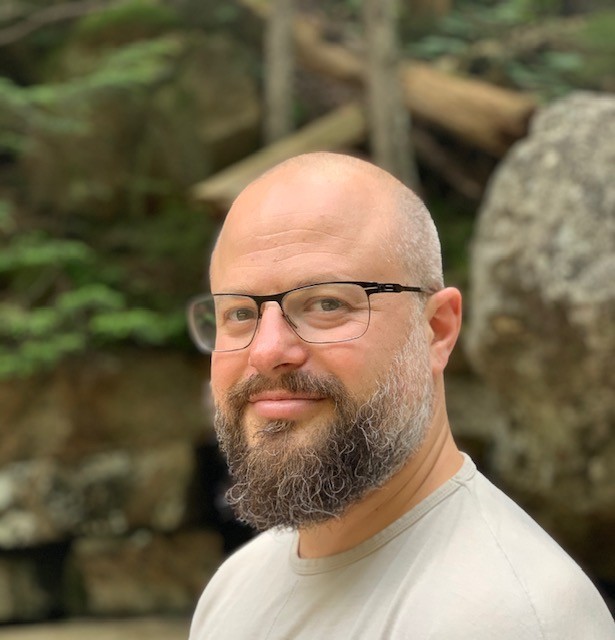
Conducted by Michael Overstreet, a doctoral candidate at the University of Virginia and a Research Assistant at the Journal of Contemplative Studies (JCS).
JCS: Thank you for joining me here today, Adam. It really is a pleasure. I’d like to start the conversation today with a question about your background. Is there a particular spiritual heritage that subtends your thought? Or maybe specific experiences that have brought you to where you are today? What helped shape your contemplative practice and the expansive, capacious thinking you have?
AL: Thank you. Well, it starts, as all good things, with Jedi Knights and ninjas. As far back as I can remember, I loved the Yodas and the Gandalfs and the wise old women in the forest. This evolved into my studying martial arts and being obsessed with Japan, Japanese aesthetics, Japanese tradition. I traveled to Japan when I was 15 as part of an exchange program. I quickly acquired a deep interest in traditional and tribal wisdom traditions. I ended up traveling to live with a few different Native cultures in North America. Then, most importantly, I spent a summer with a very small indigenous community called the Ishiru or the Chamacoco in northern Paraguay when I was 16. I ended up going through a very intense experience with that community.
All of this contributed to laying the groundwork for eventually connecting with Tibetan Buddhism. I had recognized that there was something important about the Japanese tradition, and that there was something important about the indigenous tradition. And I was looking for a way to make sense of my state of mind as an adolescent—experimenting with psychedelics, heartbroken for the first time, afraid for our future and for this planet, having recognized that industrial civilization was not leading us in a good direction. And, at that moment, when I was 16, I stumbled upon this book, The Sacred Path of the Warrior. It really changed my life. It articulated how to bring deep meditative spiritual practice together with a social vision. One could say I started meditating because of that book. And, eventually, I decided to just stay within that tradition. I went through what was essentially a 30–year journey of deep meditation, going through the Vajrayana Tantric training, and eventually becoming a teacher within that tradition.
JCS: Thank you, Adam—what a journey you’ve had. As the theme of sensemaking is what has brought us together here today, I’m curious how your contemplative practice and the traditions you find yourself anchored in have helped you make or bring sense to your world? Has your grounding in a Buddhist contemplative practice influenced how you structure your life, and has technology played a role?
AL: You know, there’s an interesting traditional Tibetan rubric: outer, inner, and secret. So I’ll use that as a little map here because it’s a big question.
On an outer level, I’m thinking that might mean something like making sense of our world and our times. The contemplative traditions I’ve been trained in have been really, really powerful in opening up different perspectives than those that are conventional or assumed. My sense of our cosmos and what it means to be alive is quite expansive in part because of actual experiences I’ve had, both in meditation and because of the worldviews that I’ve been raised within. The Tibetan tradition, for example, lives in a cosmology that we might call animist or sacred or multidimensional. In no case was it an easy pill to swallow when I started to get a sense of how deep the tradition went and how foreign it was from the world I was raised in. And yet, through embodied practices, through rituals, through relationships with my teacher and community, it became clear to me that there was this kind of multidimensionality of experience.
It is interesting that you ask how it helps me make sense, because there are also ways that it actually makes no sense, that it destabilizes the sense-making process. And I don’t even mean a big mystical destabilization. I just mean: there are times I’m in conversation with people, and the sets of assumptions they have are just different from the sets of assumptions I have. This can actually lead to a distance—the opposite of a resonance or a kind of kumbaya where we’re all seeing things the same way. It’s a splintering or fragmentation—where it’s like, whoa, I see the world really differently—and even within myself. Here we are now maybe stepping to the inner. It can lead to having multiple perspectives in my own being.
We might say this in modern psychological jargon as having different parts of myself. There’s a cosmology that lives within me that’s totalizing, that sees the world as basically a material universe, as described in modern physics. I really believe that, and not just partially; that is 100% a world for me. And I also 100% live in a world where this material universe is a reification, a pale and simplified description of something much richer and more complex, a world with various deities and living entities and ancestral presences and lineage streams. That also is a very real and alive world to me. And there are days where I’ll move between one and the other. You could call it a pluriverse or a polyontology. I think that I experience this less as something that is fragmented and more as an abundance, or richness.
Now, on the secret level, I don’t yet know what I’m going to say; that‘s how I know it‘s secret. For me, and maybe this has to do with an ultimate lack of meaning, which could be another part or aspect or maybe something even more foundational or unfoundational to it all, but I think a lot of Buddhism in particular grapples with that edge of meaning. I think mystical traditions often bring you to a point where the meaning-making process itself might be a confusion, a vast, frightening wound of knowledge and destabilization of meaning, of foundations. A kind of anarchy, or foundationlessness, is really important to the way I was trained. The practices, even the meditation techniques that I do and value have a lot to do with non-reference points and being able to open and relax beyond any concretization of meaning.
JCS: It’s interesting to hear you speak of these topics, as I come from a foundation in continental philosophy and the Western tradition; French existentialism is largely what has brought me into conversations such as this one. It helped me through a very difficult part of life. I love seeing the resonance when Western thought comes into proximity to Eastern schools and spiritualities.
AL: Well, I think it’s important for me to say that I don’t even know anymore whether I’m speaking from East or West. I have lived within phenomenology, within Heidegger’s thought, within Immanuel Kant’s. I have a deep relationship with Giorgio Agamben’s philosophy. We were mentioning Byung-Chul Han together, and Catherine Malabou’s work. These are as equal to me, as teachers and resources, as the Buddhist tradition. I learn one from the other. My whole reading of the Dzogchen tradition is influenced by Giorgio Agamben, who is influenced by Heidegger and Foucault and Walter Benjamin. I don’t even know anymore what is what. Sometimes I do. Sometimes it’s clear that I’m coming from a certain perspective. But as far as there being categories of East and West, of philosophy versus spirituality or religion, I can’t even draw the boundaries anymore.
As far as there being categories of East and West, of philosophy versus spirituality or religion, I can’t even draw the boundaries anymore.
JCS: It’s so important that we have dialogue between Eastern and Western traditions, that we have thinkers in this world who are open to both philosophy and spirituality and are able to bring them into open conversation with one another. It makes me think of how post-secularism is on the rise in critical thought. And so, on the note of opening and dialogue, I’d ask you about how your contemplative and/or intellectual practices help you make an impact in the world. In what ways do you find that these practices of yours can have an impact, and how do you activate, or mobilize them?
AL: Most of my time and my work these days is in the ecological field. I have a certificate in eco-psychology and I’ve actually been teaching eco-psychology in a sustainability master’s program at Chatham University for the last few years. The on-ramp for me from my background in Buddhism and teaching meditation into the ecological world was through eco-psychology: helping to find ways of living with the existential crisis we’re in as we erode the very natural systems we depend on. This field isn’t simply psychological in the sense of inner emotional understandings of the psyche. It is cosmological, shared and intersubjective. I think it’s one of the foremost realms that we humans alive today need to be really exploring. I don’t think we’ve even begun to metabolize the loss that’s already happened. This loss of so many species that we evolved with on this planet for billions of years, the shifts in our water flows, animal migration patterns, heat flows. This is huge—what are the psychological ramifications of this widespread mutation of the natural world?
And so, from my work in eco-psychology, I began to get involved in more conventional environmental activism. I’m very involved with resisting the petrochemical build-out in western Pennsylvania, where I live. To share one of the specific projects that I’m involved in, we’ve been bringing people from the city and from all over out to the large petrochemical sites. So I work with one plant in particular, a shell plastic plant. We rent school buses and bring people out—activists, academics, people that work in museums—to the sites of these petrochemical plants, because they’re often hidden. You don’t really see them. We go there and have a somatic, embodied, direct, sensual, sensory experience of these giant places. This is a 356–acre massive plant. I lead people in a wandering practice to just see it with their own eyes and sense it and smell the pollution and hear the whirring of the machines. We sit in a circle and do grief practices together. We do some work in pairs. Sometimes it’s kind of ceremonial and includes ritual offerings depending on who’s there and how far they’re willing to go. This has become really important for me: bringing the training I’ve had in Vajrayana Buddhism and in Western philosophy together with the ecological and climate crisis that we are all part of. This is one specific way through which this work becomes very grounded, very tangible, and very elemental for me. There are so many resources within, let’s say, the Dzogchen tradition, about working with the elements, about seeing the non-duality of body and earth, of human and more-than-human. So, for me, the terms of awakening, realization, non-duality, Buddhahood, are increasingly unearthed; you could call them elemental or material. Awakening, for me, is less about an inner cognitive shift and much more about collective and planetary flourishing.
Awakening, for me, is less about an inner cognitive shift and much more about collective and planetary flourishing.
JCS: Your work is very inspiring; that you are actually out there putting boots on the ground and engaging others in ecological thought. One last question for you, Adam. Where is your curiosity taking you these days? Is there a horizon or a dark forest that is yet to be explored for you? What’s pulling you right now?
AL: You mentioned technology before, and this is a good opportunity for me to bring that in. As hopefully was exemplified in my paper, a lot of my curiosity is around these emerging realms of AI, generative AI, technology, and the digital world. And part of my curiosity comes from meeting some really wonderful people, many of whom are here at this conference, who have big hearts, really sharp and clear minds, and are doing wonderful work bringing contemplative practice and technology together. I’m so happy and thankful that there are good people in that world doing amazing work. Much of my own political and philosophical formation is in direct resistance to this arising excitement around the digital world and artificial intelligence. I mentioned Heidegger before. His question concerning technology is really important to me. He recognizes that technology is not simply tool use, but a metaphysics. It’s a way of seeing what is even thinkable and what is valued in our world. I have a lot of questions, and I think I often find myself more hesitant or questioning than a lot of people who are celebrating this technological synthesis. But I’m not a full Luddite. I’m not in full resistance. I’m very interested. It seems inevitable—you can’t put the genie back in the bottle.
In particular, I’m curious about the sheer force and momentum of what is conceived of as innovation, technology, progress, and technological design. How can that energy not contribute to ecological destruction, to the ongoing decimation and destruction of cultural forms of knowledge, those that aren’t valued and aren’t getting trillions of dollars of investment? The epistemic signs, the death of knowledge, systems of ways of knowing. How can this not be part of the destructive runaway train, that which we’ve seen through modernity, through hypercapitalism and neoliberalism? Is there a way that this arising can actually settle into the intelligences of the planet and our bodies and our cultures that are already here? My sense is that there is a deep planetary intelligence or intelligences that run through forests, that run through mycelial structures, that run through the speech of birds, through human cultural, linguistic, and mystical systems. There’s so much intelligence and abundance and generosity already here that does not need to be innovated and does not need to be created and that we can relax with, that we can trust, that we can rest in. So, in the end, I’m curious about how this view I just tried to express can meet the excitement of these new technologies, and I find myself at the threshold of those two perspectives.
There is a deep planetary intelligence or intelligences that run through forests, that run through mycelial structures, that run through the speech of birds, through human cultural, linguistic, and mystical systems.
JCS: Wow, thank you so much for your thoughts, Adam. It was a pleasure.