SENSEmaking: A Symposium on Contemplative Technologies was held by the Contemplative Sciences Center and its Contemplative Innovation + Research Co-Lab (CIRCL) on October 9th and 10th. Contemplative practices in esoteric and religious traditions have long sought to explore the horizon of human cognition and sensorium. How can these traditions inform the ways we make sense of our worlds? Can modern innovations in design and technology help enrich and expand this relationship between contemplation and the human capacity for sensemaking? A collaboration between modern science, technology, and ancient wisdoms, the SENSEmaking Symposium showed that the horizons of human cognition expand beyond the reaches of one’s own perception, allowing our understandings of the human to dilate beyond ourselves.
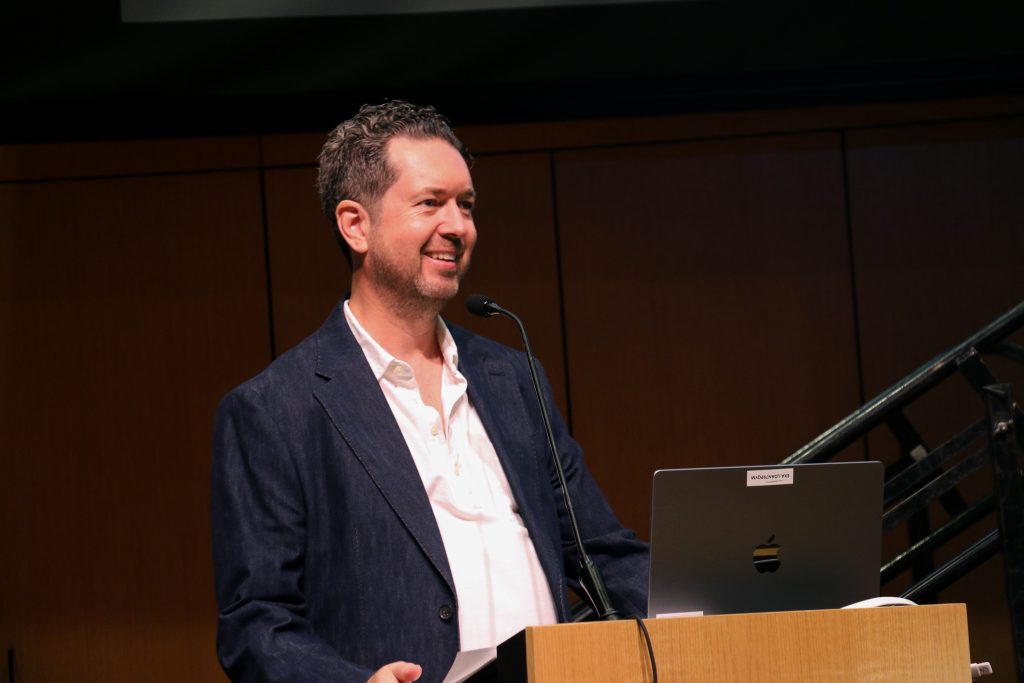
Kelly Crace and Michael Sheehy opened the symposium with statements of gratitude, humility, and excitement for the next two days’ events. The nearly two-hundred attendees and participants were then guided through a half-hour meditation by Sufi scholar, school-founder, and spiritual leader Pir Zia Inayat Khan. The resolute drone of his voice asked each mind within the capacious, sun-drenched conference room to focus on its embodiment, to ponder what our bodies connect us to. His words were infused with verse: occasional rhymes in his slow and meandering speech created a rhythm that ushered our inward-facing attention to dilate and diffract. The room filled with the warmth of collaboration, beginning the symposium with a community made by collective intention.
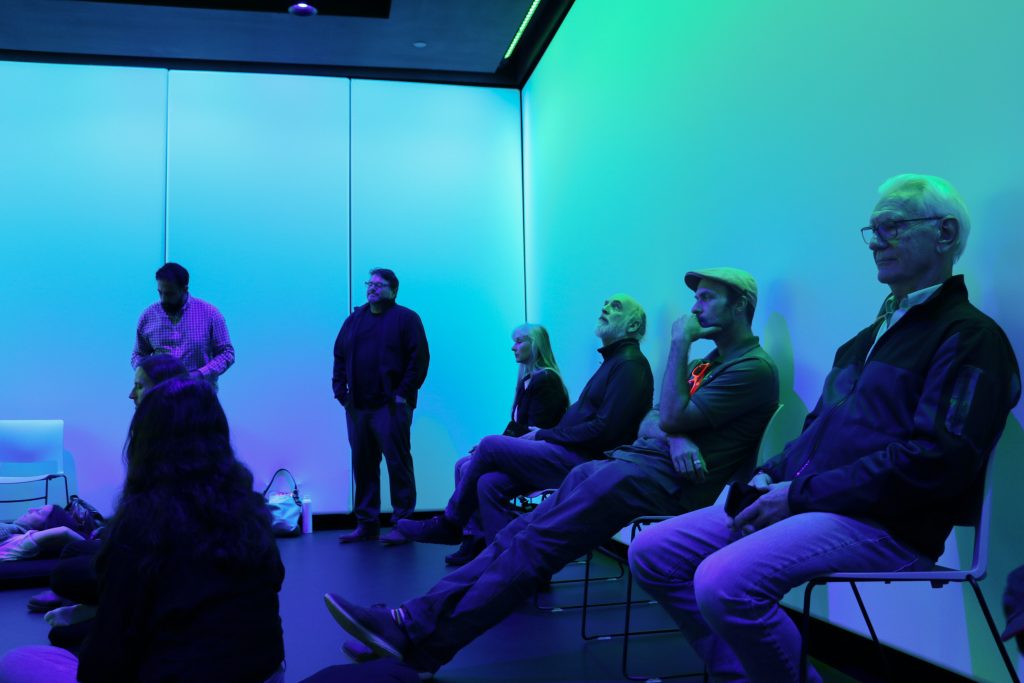
Guided meditations led by members of the symposium both opened and closed each day’s events in the Contemplative Commons. Beyond these distinct moments, contemplative practice could be encountered through the building itself. At the center of the Commons, Wolfgang Buttress’s immersive installation Ninfeo translated the underwater sounds of the adjacent Dell Pond into the reach of human perception. Walking into the darkness of the Nymphaeum, a person’s presence illuminates in vibrant colors thousands of crystal tiles etched with aquatic plants, their shadow becoming part of the humming life beneath the surface of the pond.
On the fourth floor, Matthew Burtner’s installation Morven Resounding brought field recordings of birdsong, wind, and insects into the immersive language of light and sound, allowing us to experience rhythms of the natural world that would otherwise remain beyond the reach of our attention. Down the hall, David Glowacki led with guitar and song a guided contemplation of the deity he’d created while exploring the reaches of the human psyche using Ayahuasca in the mountains of Chile. Composed of tens of thousands of painted pieces of laser-cut aluminum, the dark eyes of the awe-inspiring Tara Pachamama reflect back at those who look upon her gaze the very peace and connection growing within themselves.
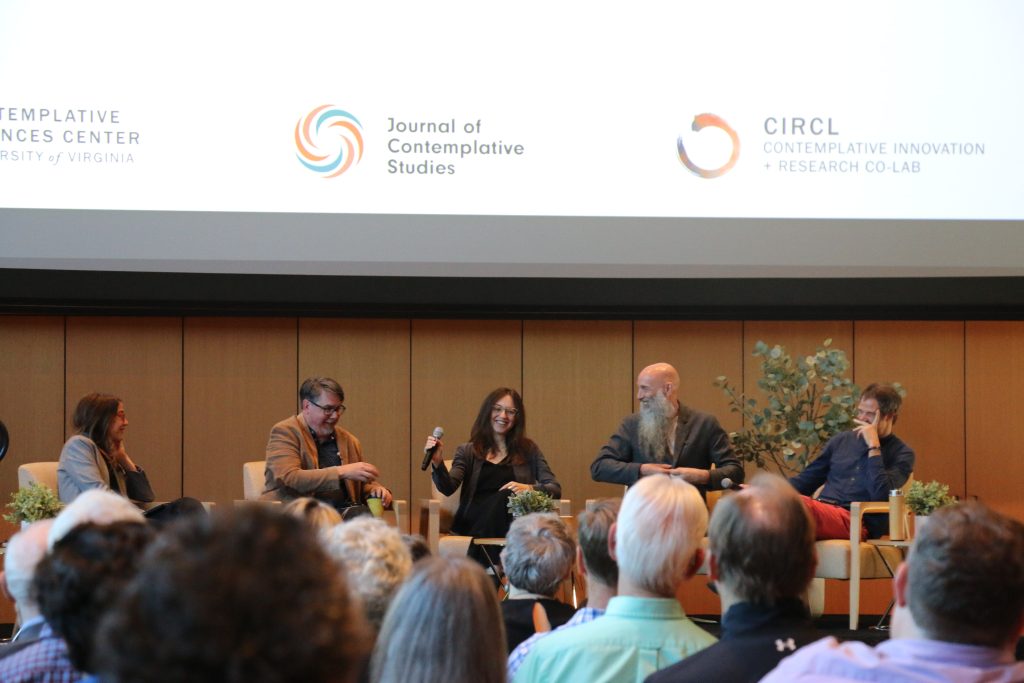
The first session of the symposium centered itself on sensemaking: how does our individual perception and interiority affect the way we experience the world? What happens to our worldview, for example, when technology allows us to sense the constant activity and hear the communication of the pollinators in our area? Eco-artist Wolfgang Buttress’s immersive sculpture The Hive (housed in Kew Gardens, London) becomes alive with light and sound once a visitor steps within it. Data from vibration sensors cached within a real local beehive translates into an immersive hum and illumination, filling the visitor’s experience with the now-perceptible communication of one of agriculture’s most important, endangered allies. When we perceive something, we can begin to attribute value to it.
This is precisely the reason why the grief that follows an unexpected loss in our lives can be such a profound and transformative phenomenological experience. As philosopher of mind Jelena Markovic mused, what does it mean when we begin attributing such intense cognition, and value, to someone or something that is no longer sensorially perceptible, that no longer exists in the material world? This is the line that brought the panel’s discussion to the subject of psychedelic-assisted contemplation – what are the affordances of perception-expanding substances for contemplative practice? Buddhist Studies scholar James Gentry explored this question through historical practice texts. He discovered how some Tibetan Buddhists have historically ingested substances to help induce visionary meditative experiences, allowing them to perceive, and focus on, that which is beyond the horizon of normal cognition. From David Glowacki’s first-person account, the implications of these kinds of traditions are manifest: using psychedelics to contemplate the divine can help us translate the sacred and that which lies beyond human perception into the physical plane and collective sensorium.
How important, specifically, is our sense of hearing for our experience of the divine? Can new sound technologies help us sensorially experience that which normally is without a sound? In the second session, musical artist and professor Jovia Armstrong showed how applying additional reverb to certain pieces of her music created a moment of perceptual liminality: one’s cognition is led to linger behind the notes, contemplating the trace and residual presence of sounds that had already transitioned to different form. It is a compelling question, isn’t it? How do past experiences of sound affect the way we perceive the world in the present? Clinical pain psychologist Patrick Finan spoke of the way that music, specifically that with which we have built an attachment to over time, holds a certain perception-bending power. Listening to music that we love can lead to a significant decrease in the amount of physical pain we perceive. Are we anything more than our senses and perception? In a time when there is so much atomization of communities and alienation of people from the natural world, it seems like we might treat these as problems of an anesthetic nature: as something that has removed our capacity for collective sensemaking by first having inhibited the possibility of connected sensorium. The question might become, then, that of cultivating meaningful aesthetic experiences: those that bring our interconnection with others and the natural world into our immediate and felt perception.
Such was the line of thinking of interdisciplinary artist and poet Kythe Heller. How can we use art to help bring awareness, value, and attention to the connection between our own discrete sensorium and the universal materiality of which our bodies are inextricably part? How do we bring cultural attention to the intrinsic, material intimacy of the human experience? As professor of Eco-Psychology Adam Lobel helped us see: the air allowing our voices to reach one another in conversation is the very same air that we and our neighbors breathe, that our forests produce—and it is this air into which new AI data centers spew carbon monoxide and formaldehyde. Contemplation of our aesthetic experiences allows us to perceive the effects of the destruction and pollution of our environments on the emotional and spiritual planes of existence. How can the capacity of music and sound to bring together and transform individual interiorities help to spread awareness of just how plastic and radically vulnerable a human being really is?
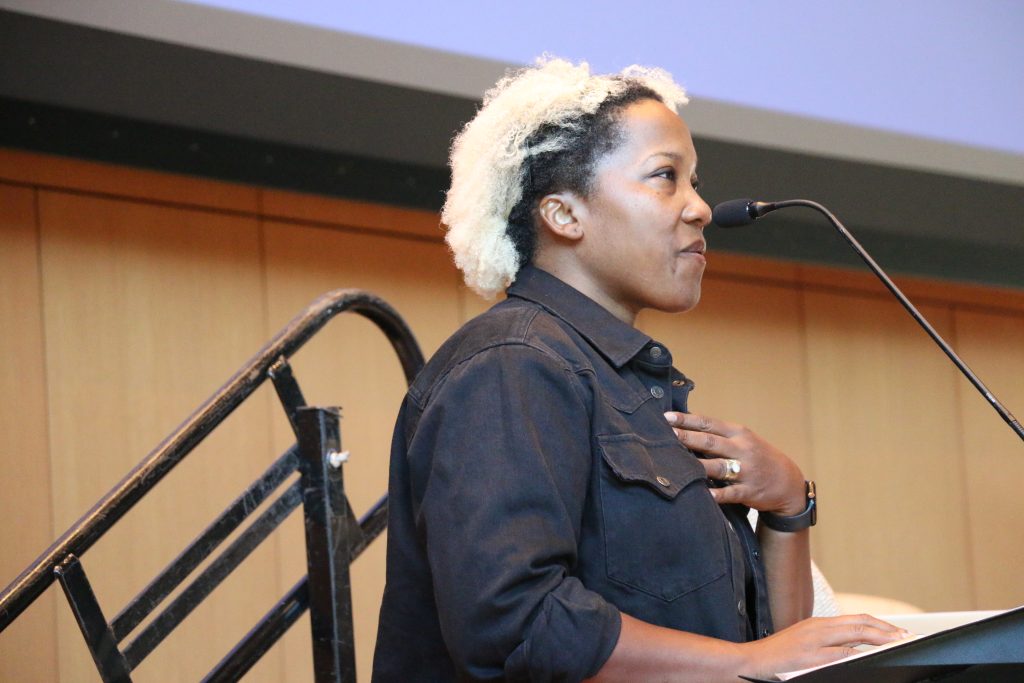
Vision is commonly conceived as our primary sense of perception, and we live in a world saturated with excess light, screens, commercial advertising, and constant optical stimulation. Hence writer and contemplative Andrew Holecek, in the symposium’s third session, detailed his practice of going on periodic “dark retreats,” isolating himself in pure darkness for multiple weeks at a time. In effect, how can eliminating and reducing the visual clutter we experience on a day-to-day basis allow our insight to grow and thrive? Or, on the flip-side of the coin, how can we utilize the primacy of vision in our human experience to help foster ecological and interpersonal connection? Media artist Jesse Fleming pursues this question through vibrant, multi-modal, and immersive art installations that show how changing what is in one’s field of vision can recreate one’s entire world.
It is an interesting thought experiment to reflect on how sermons, gospel, and prayer are so often based in listening, in the contemplation of the signified meaning of words from their sounds. Are such religious experiences different from when there is visual experience of the divine word? Scholar and professor of Jewish Studies Greg Schmidt Goering guided the audience through a close reading of passages within the torah, arriving at the presence of a certain synesthesia: God’s word often blends with descriptions of the perception of changes in light, enabling and encouraging the reader to believe that somatically informed cognition of more or less mundane experiences are not distinct or reducible from the divine. The stars or celestial bodies of the night sky were indeed once the foundation of ancient epistemologies and belief systems. As astronomer Kelsey Johnson’s informed us, due to light pollution, most of the world can no longer experience a truly dark night sky. Most people of the world will never be able to see and know how the darkest moments of our terrestrial lives allow us to perceive the universe as an infinite expanse of increasingly diffracted and diffuse light. What does it mean for our spiritual wellbeing that we have begun producing so much light that we can no longer see the light of the universe?
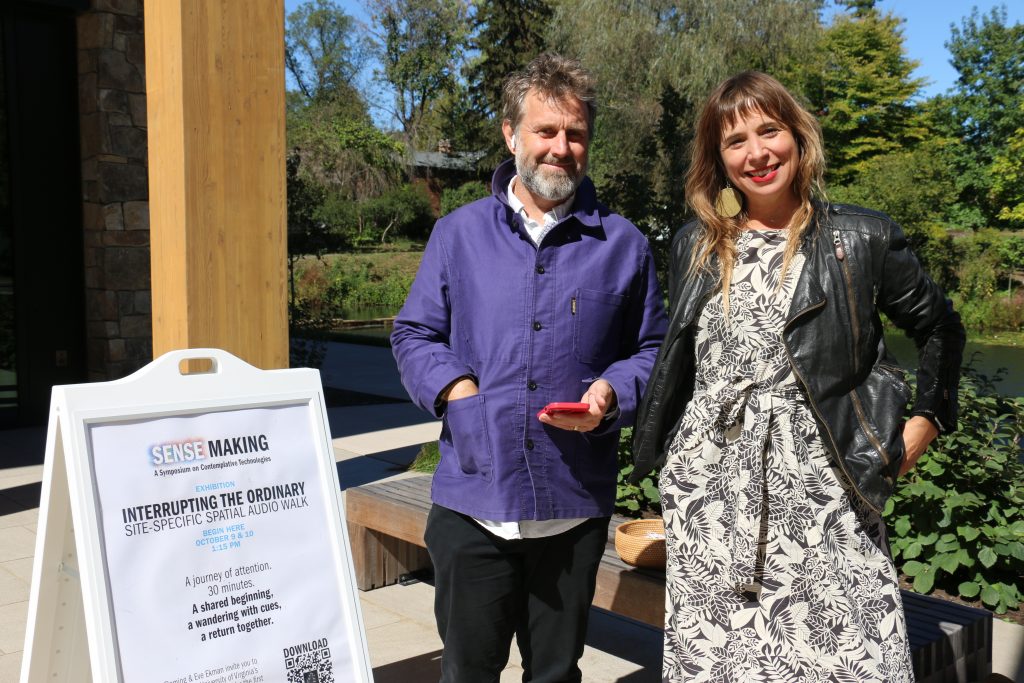
Such questions are precisely why the final session of the symposium investigated the affordances of contemplation and technology for facilitating extrasensory perception. If technology and modern life has cluttered our sensorially perceptible world, perhaps the answer lies beyond our senses. This discussion synthesized many of the topics of the other panels by asking: how can we help create a more inherently relational and collective sensorium? Designer and engineer Mikey Siegel pursued this question using sound and light technologies. By hooking up portable lights to people’s heartbeats, one can perceive the life rhythm of others. In exchanging one’s own pulsing heart-sourced light with a partner allowed Mikey to study the way feelings of emotional connection increase in and through aesthetically experiencing another’s existence. This asks an at once important and fascinating question: do emotions and affect originate in the physiological rhythms of the body or in our cognitive perception of them? Social scientist Eve Ekman walked us through contemporary understandings of emotions and mused whether it’s possible to cognate without their influence. It seems like most of us would agree that it’s not, so the question is rather: how do we learn to live alongside them? This is where the boon of contemplative practice comes in—how can one learn to cultivate a critical remove from thoughts and processes occurring within one’s own cognition?
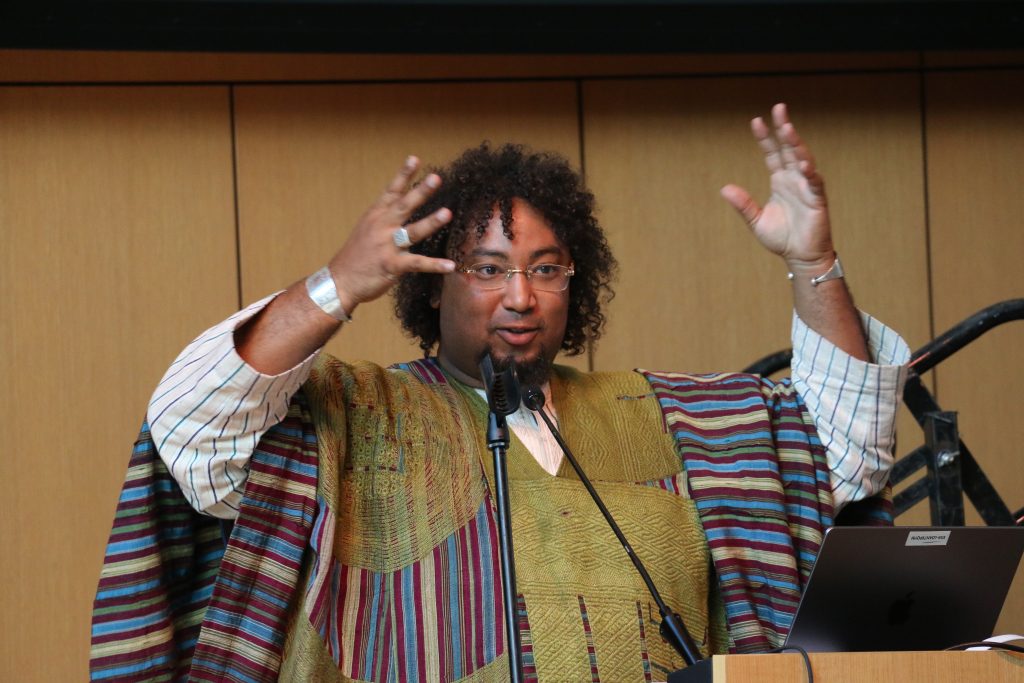
Neuroscientist Michael Lifshitz showed just how powerful contemplation can be for changing the way one thinks with his work exploring “tulpamancy.” By dint of sheer concentration and long-term discipline, practitioners of tulpamancy claim to create an additional subjectivity within their consciousness. There is empirical evidence showing how we can conjure imaginal friends, and far from being a sign of immaturity or psychosis, communicating with a “tulpa” has been found to increase emotional resiliency, decrease feelings of loneliness, and even increase neuronal plasticity. Beyond fostering connectedness, contemplation can quite literally cultivate new perspectives within oneself and also, then, within their wider community. Such was the line of thought pursued by professor of Africana Studies, Oludamini Ogunnaike, who spoke on the resonance between Sufism and the indigenous religious tradition of Ifa. The dilated sense of self that religious contemplation can yield, in both Sufism and Ifa, highlights the unicity of one’s individual experience all while emphasizing their affinity with not only others, but with the material universe too. This affinity can only be felt, for Ogunnaike, through love.
Matthew Burtner made the closing remarks of the symposium speaking of his work recording and making music with natural soundscapes, inviting us to question who, or what, can be sense-makers. Matthew described the translation of biorhythms and non-verbal communication of oysters and glaciers into poetic form: symbiotic, artistic collaborations that allows human beings to become conscious of the nonhuman lives and environments upon which we depend. Contemplation of such vibrational frequencies closed the symposium as Karianne Michelle guided us through a sound bath. By the time the halls were buzzing with the reception, there was a feeling of serenity, reverence, and unabashed effervescence. An almost tangible optimism traversed the various conversations; the air felt lightened by the presence of goodwill, curiosity, and collective intention. By bringing the practices of contemplation and ancient wisdom into conversation with modern science and knowledge, SENSEmaking allowed us all to see, hear, and ultimately believe that, although technology has done much to distract us from the interrelatedness between ourselves and the more-than-human world, it can also help us find new ways of revitalizing and perhaps even expanding the ways we understand our interconnection.